IS GOOGLE HAVING ITS
YELLOW PAGES MOMENT
TL;DR: 📈
- Short answer, yes, the early signs are there: in Q4 2024 Google's global search share fell below 90% for the first time since 2015, and internal Google documents describe further search decline as "inevitable".
- AI search is growing fast: ChatGPT reached 100 million users in two months, Perplexity handled roughly 780 million queries a month by May 2025, and 52% of US adults have now used an AI chatbot.
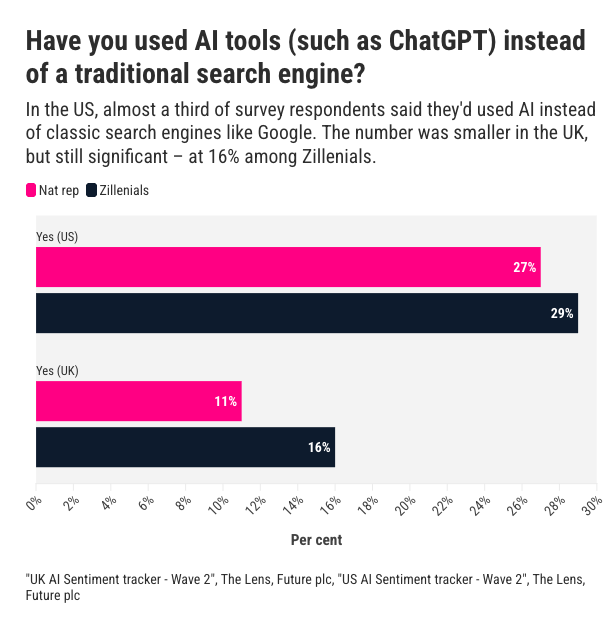
- The shift is behavioural, not just technical: 27% of US and 13% of UK users say they already turn to AI tools instead of a search engine.
- It bites hardest on high-intent queries: one study found AI search visitors convert about 23 times higher than ordinary organic visits, exactly the commercial searches that fund Google's ads.
- What financial services firms should do: start optimising to be cited inside AI answers now, before competitors do, rather than waiting for the shift to finish.
Google is showing the earliest signs of the same disruption that ended Yellow Pages' dominance. In late 2024 its global search share slipped below 90% for the first time since 2015, its own executives have reportedly described further search decline as inevitable, and AI platforms such as ChatGPT and Perplexity are absorbing the high-intent, commercial queries that fund Google's advertising business. This is not a collapse, and Google may still adapt, but the direction of travel now looks a lot like the late 1990s did for the print directory industry. I know, because I watched that one happen from the inside.
Share this article:
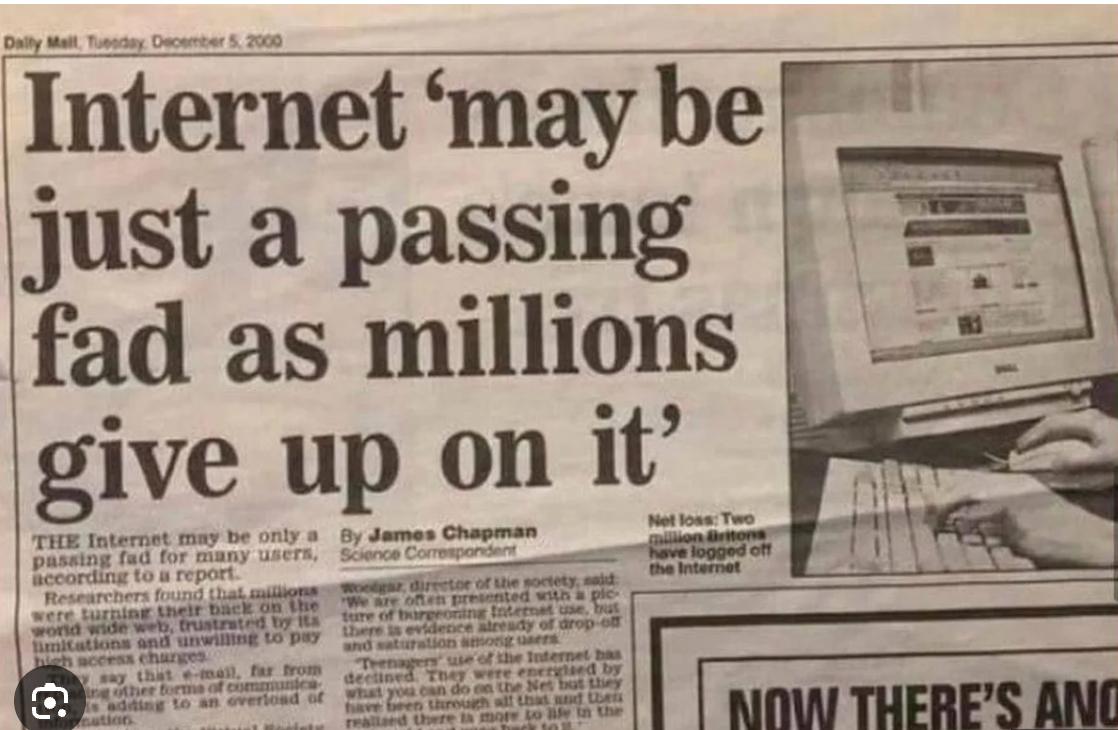
What Does My Yellow Pages Experience Have To Do With Google?
I saw a dominant information business dismiss a technology that went on to destroy it, and the pattern rhyming today is why I take Google's position seriously. I started as an advertising account executive for Yellow Pages in 1989. It was a brilliant job, excellent money, a solid corporate structure, a clear mission, and advertisers genuinely received value for their investment. For years we dominated local business discovery, and our thick directories were essential tools in every home and office.
Then something extraordinary happened. The internet arrived, and with it, Google.
How Did Yellow Pages React To The Internet?
It denied the threat and rewarded the people who ignored it. What fascinates me about that period was not just the technological shift, it was the management response to early warning signs. In countless meetings throughout the 1990s, senior management relentlessly pushed paper directory sales over everything else, and a peculiar form of natural selection emerged within the company.
The internet hit London first and hardest. Managers there began missing targets because their quotas remained anchored to print advertising whilst customers were already embracing web-based solutions. Meanwhile, managers in northern England and Wales continued hitting targets easily, because their customers had not yet discovered the internet's potential.
This created a bizarre promotional pattern. Managers who succeeded in areas with lower internet adoption were promoted to southern offices. Soon, London was managed by executives who had thrived precisely because they had not adapted to digital change. We ended up with an echo chamber of leadership convinced that Yellow Pages directories remained supreme.
I vividly remember one meeting with a very senior manager who declared, in a thick northern accent: "Oh no, our customers are loyal. They understand we help them. They'll never move away from us."
I thought him utterly clueless. Customers were constantly seeking alternatives to what they perceived as our stranglehold monopoly. They resented our above-inflation price increases and would have relished any opportunity to abandon us entirely.

What Was The Mobile Prediction Yellow Pages Ignored?
I proposed putting the Yell.com search app on every new mobile phone, years before the iPhone, and the idea was ignored. Around 2006, I attended a business function in Manchester. As someone who worked extensively on the internet side of Yellow Pages at the time, I was speaking to a very senior manager about the future. I made the case that internet on mobile phones was inevitable, though I knew nothing about the coming iPhone.
I proposed that we should establish a partnership with O2, the UK mobile network provider, to ensure that the Yell.com search app shipped with every new phone they sold. I argued that even though data was expensive then, prices would come down dramatically, and we needed to be the first thing everybody used when they got their internet-enabled phone.
I was asked to write a report on this proposal. I did. It was ignored and disappeared without a trace.
This management attitude proved catastrophic. Later, Yellow Pages lost approximately 90% of its share price in a year as Google's impact became undeniable and pay-per-click advertising revolutionised how businesses reached customers.
Is Google Actually Losing Its Grip On Search?
Yes, the first measurable cracks have appeared after nearly two decades of near-total dominance. For most of that period Google commanded over 90% of global search traffic, and the raw scale is still staggering:
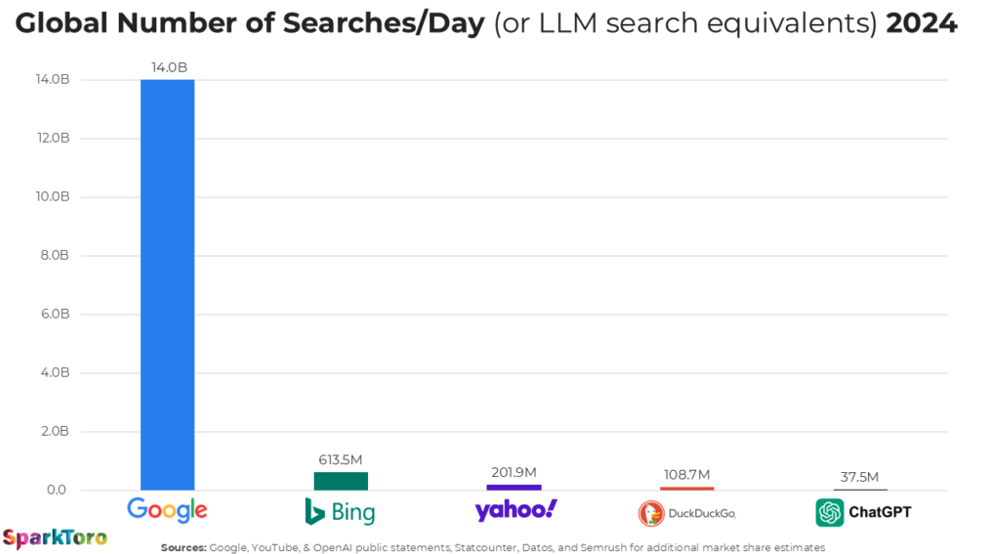
- Google processes over 5 trillion searches per year, roughly 14 billion searches a day
- As recently as 2024, Google's search query volume grew 21.6% year-on-year
- Google handled approximately 14.0 billion searches daily in 2024, dwarfing every competitor
Source: SparkToro, new research on Google search growth in 2024
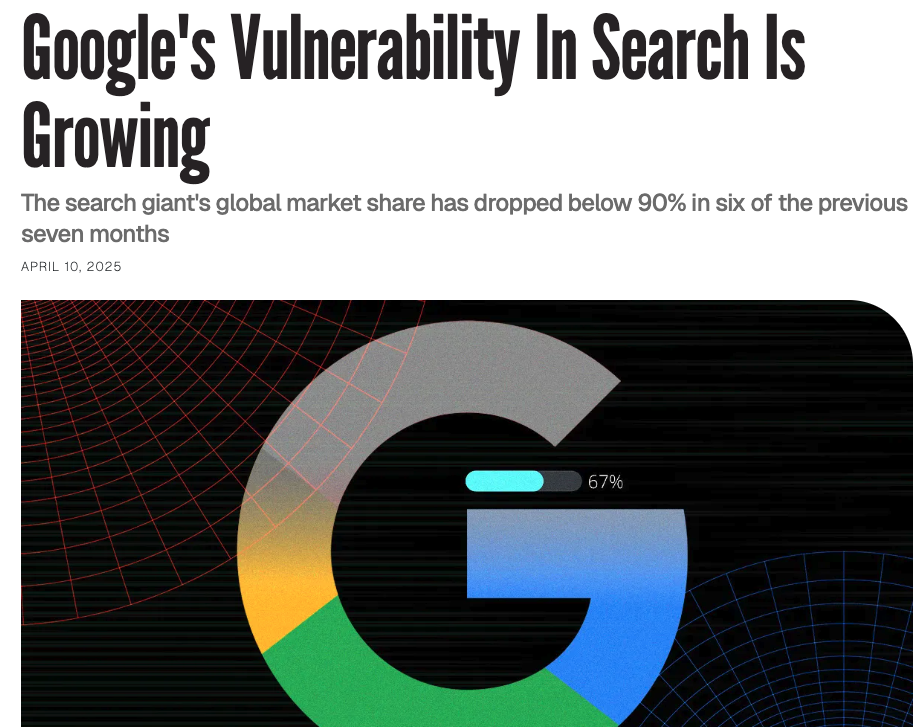
The cracks are these. By Q4 2024, Google's global search engine market share fell below 90% for the first time since 2015, averaging around 89 to 90% through early 2025.
Source: Adweek, Google's search vulnerability
More significantly, one investment analysis suggested that Google experienced its first year-on-year search volume decline in 22 years. Internal Google documents reveal that company executives believe search traffic decline is "inevitable" as users migrate to AI chatbots, and Google's leadership has reportedly urged urgent efforts to monetise AI-driven search features to offset the trend.
Source: Search Engine Land, Google search traffic decline described as inevitable
How Much Money Does Google Have Riding On Search?
Almost all of it, which is why even a small decline matters so much. Search advertising remains Google's financial foundation:
- In 2024, Google Search generated approximately $198 billion, roughly 61% of parent company Alphabet's total revenue
- About 77% of Alphabet's total revenue came from advertising in 2023
- Google Cloud services contribute only 10 to 13% of revenue, and YouTube ads around 10%
Sources: Oberlo statistics and Bullfincher, Alphabet revenue by segment
Because the business is so concentrated, even a modest 5% decline in traditional search queries could translate into billions in lost advertising opportunities. Gartner analysts have predicted that traditional search engine volume could drop 25% by 2026 as AI chatbots gain popularity.
Source: Datos, on the predicted 25% drop in search volume
How Fast Is AI Search Actually Growing?
Fast enough that it went from zero to hundreds of millions of queries in about two years. The challenger this time is not another search engine, it is a set of artificial intelligence platforms that reimagine how people seek information. Here is how the main players compare.
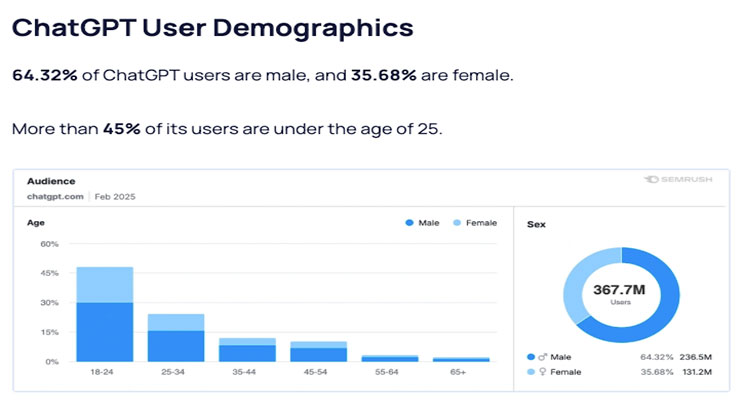
How Big Is ChatGPT Compared To Search?
ChatGPT is the fastest-growing consumer application in history, and roughly a third of its use looks like search. OpenAI's ChatGPT launched publicly in late 2022 and broke every record:
- It reached 100 million monthly users within just two months, the fastest-growing consumer application in history
- By December 2023 it reached approximately 180 million users with 1.7 billion monthly site visits
- By late 2023 it was handling about 1 billion messages per day from users
Source: Exploding Topics, ChatGPT user statistics
Crucially, roughly 30% of ChatGPT prompts are search-like information requests. Users ask for travel advice, product comparisons and explanations where they might previously have "Googled it". By 2024, ChatGPT was handling an estimated 37 million search-equivalent queries daily.
Source: SparkToro, on search-like ChatGPT prompts
What About Perplexity, Bing And Gemini?
All three are growing, with Perplexity scaling most sharply as a direct search replacement. Perplexity AI is a large language model powered search engine that answers queries directly with cited sources:
- It handled about 250 million queries in July 2024 alone, half its total for all of 2023
- By May 2025 it was seeing roughly 780 million queries per month, approximately 26 million searches daily
- It reached about 15 to 22 million active users by 2025
Source: Just Think AI, on Perplexity's monthly query volume
Microsoft integrated AI chat, powered by OpenAI's GPT-4, into Bing Search:
- Bing's overall search share has ticked up to around 4% globally
- In 2023, Bing.com saw about a 6% increase in its share of the search audience
- However, only an estimated 4 to 9% of Bing users engaged with the chatbot monthly
Source: StatCounter, search engine market share
Google launched its own conversational AI, Bard, now Gemini, in response:
- Despite a rocky start, by early 2025 Google's Gemini had become the second-largest AI search tool by usage, behind ChatGPT
- Google's CEO noted that AI summaries in search led to increased search usage among testers
- However, AI overviews often reduce clicks on results, with one study reporting a 70% drop in clicks when AI answers were present
Are People Really Replacing Google With AI?
Yes, and the behavioural evidence is exactly the kind Yellow Pages dismissed in the 1990s. Multiple independent studies now point the same way.
What Do The Surveys Show?
They show a meaningful minority already switching, and a majority experimenting. A December 2024 survey revealed dramatic shifts in search behaviour:
- 27% of US respondents now use AI tools like ChatGPT instead of search engines
- 13% of UK respondents have made the same switch
Source: TechRadar, on people swapping Google for ChatGPT
A March 2025 study by Elon University found:
- Over half, 52%, of US adults have now used an AI chatbot or large language model
- Among those users, two-thirds use these AI tools like search engines for finding information
- "Using them as a search engine" was the single most common use case
- 34% of large language model users engage with an AI tool daily
Source: Elon University, survey on US adults using large language models
Why Do High-Value Searches Matter More Than Volume?
Because AI is capturing the commercial, high-intent queries that actually generate revenue. Whilst AI search currently represents only 0.5% of total web traffic, it generated 12% of all conversions in one study, which suggests AI-driven searches convert about 23 times higher than ordinary search visits.
Source: PPC Land, on the Ahrefs AI search conversion study
This implies users turn to AI for more complex, high-intent queries where they are more likely to take action, exactly the type of valuable searches that drive advertising revenue. The same pressure is visible in zero-click behaviour. Even before AI, an estimated 58% of Google searches already ended without a click, and AI snippets are accelerating that trend.
Source: Writesonic, on ChatGPT's impact on Google search traffic
What Am I Seeing With Our Own Clients?
New clients increasingly find us through AI rather than Google, even when they say "Google" first. When I now ask new clients how they discovered our financial marketing services, several of the most recent ones initially said "Google", but when pressed they clarified they meant AI search through ChatGPT. One specifically mentioned using ChatGPT Deep Research to find us, and this year many have simply said "AI".
Personally, I have largely abandoned traditional Google searching. Whilst Google now displays AI responses atop search results, I find them less satisfactory than dedicated AI platforms. Instead of searching "best snowboard boots", I will ask Perplexity or ChatGPT to "find reviews of the best snowboard boots and rank them by importance and review quality". This mirrors the anecdotal evidence that Yellow Pages management dismissed in the 1990s. Early adopters were already changing behaviour, but leadership refused to acknowledge the implications.
Does Google Still Dominate Search By Volume?
Yes, by a huge margin today, which is exactly why the trend line matters more than the snapshot. Google still vastly outnumbers competitors in raw search volume:
- Google: approximately 14 billion searches per day
- Bing: approximately 613 million searches per day
- ChatGPT: approximately 37.5 million search-like queries per day
- All AI tools combined likely account for under 2% of search queries in 2024
However, focusing only on current volume misses the rapid trend and the strategic threat. AI platforms have exploded from zero to millions of queries in just two years, and they are changing how people search in ways that could significantly affect Google's growth. Early 2023 to 2024 data showed Google's share of combined traffic, alongside Bing, Yahoo and OpenAI, dipped from 91.5% to 90.7%. By late 2023, around 18% of online users had tried ChatGPT at least once in a month, up from essentially zero a year earlier.
Can Google Adapt To AI Search?
It can on the technology, but its advertising business model is the harder problem. Google is not standing still. The company is investing heavily in AI integration, attempting to evolve search whilst retaining users within its ecosystem. Early testers of Google's AI search reportedly conduct more searches thanks to conversational follow-ups, and Gemini has achieved notable usage behind ChatGPT.
The difficulty is the classic Innovator's Dilemma. Google's revenue model depends on the traditional approach of ad-supported result lists. AI answers do not naturally generate the same ad volumes or clicks, creating a scenario where Google executes perfectly on technology integration but still sees revenue per search decline.
This parallels Yellow Pages' own online directory development. They built digital products, but found them far less profitable than their printed directories. The business model that made Yellow Pages dominant could not translate to the new medium. Google's leaders do appear more aware of the threat than Yellow Pages ever was. CEO Sundar Pichai has called 2025 a "critical" year for Google's AI strategy, and internal discussions acknowledge the need to match ChatGPT's popularity.
What Should Financial Services Firms Do About AI Search?
Start getting your firm cited inside AI answers now, rather than waiting for the shift to finish. For financial services firms witnessing these changes in search behaviour, the practical response is to adapt marketing strategy before competitors do. Here is where to focus.
- Structure content to be quotable by AI: lead each page with a direct, self-contained answer to the question a client would actually ask, so a large language model can lift it cleanly.
- Publish genuine expertise and first-hand data: AI tools favour original, well-sourced material over generic explainer copy, so proprietary insight and named sources help you get cited.
- Protect high-intent queries: prioritise the commercial questions that lead to enquiries, because those are the searches migrating to AI first and converting hardest.
- Diversify beyond a single channel: shift some budget and content toward AI-optimised discovery rather than relying solely on classic Google rankings.
- Measure AI referrals: track how many new enquiries mention ChatGPT, Perplexity or "AI", so you can see the shift in your own pipeline.
Forward-thinking organisations are already exploring how expert AI consulting services can help them pivot their digital strategies to capitalise on new search paradigms before their competitors catch on. The firms that move early gain the same advantage the early web adopters had over Yellow Pages' loyal, print-only advertisers.
The Verdict: Is Google Having Its Yellow Pages Moment?
The evidence suggests yes, though the outcome is not predetermined. Google faces measurable user migration to AI platforms, first-ever market share declines, and internal acknowledgement that traditional search traffic loss is "inevitable". User expectations have evolved toward natural language responses and conversational assistance, areas where large language models excel.
The question is not whether change is coming, but whether Google can navigate the transition. If it integrates AI effectively whilst remaining the default information gateway, Google could emerge stronger. If it underestimates the pace of change, or fails to deliver AI experiences comparable to independent rivals, we might witness a steady erosion of its empire.
Yellow Pages once seemed unassailable. The thick directories were ubiquitous, trusted and profitable. Yet within a few years of widespread internet adoption, they became largely irrelevant. Google's search empire, whilst vast and currently profitable, is not immune to the same forces of creative destruction. The company that displaced Yellow Pages now faces its own potential displacement, and Google's real challenge is ensuring that "Google it" remains as natural in 2030 as it was in 2010.
Frequently Asked Questions
Is Google search dying?
No, not dying, but declining at the edges for the first time in years. Google still handles around 14 billion searches a day, yet its global market share fell below 90% in Q4 2024 for the first time since 2015, and internal executives have described further search decline as inevitable as users move to AI chatbots.
Will AI replace Google?
Not wholesale in the near term, because Google's volume still dwarfs every rival, but AI is replacing Google for specific high-intent tasks. Studies show 27% of US and 13% of UK users already use AI tools instead of a search engine, and AI search visitors convert about 23 times higher than ordinary organic visits, so the commercial core of search is most exposed.
What is AI search or generative search?
It is search where a large language model answers your question directly, often with cited sources, instead of returning a list of blue links. Tools like ChatGPT, Perplexity, Google's Gemini and Microsoft Copilot let you ask in natural language and get a synthesised answer, which is why roughly 30% of ChatGPT prompts are search-like requests.
How do businesses get found in ChatGPT and Perplexity?
By publishing clear, well-sourced, answer-first content that a language model can quote confidently. That means leading each page with a direct answer, using natural question headings, citing credible data, and demonstrating genuine expertise, so the AI treats your firm as a reliable source worth surfacing.
Is SEO still worth it in 2025?
Yes, but it now has to serve both traditional rankings and AI citation. Classic search still drives the majority of volume, so it remains essential, while the same structured, authoritative content that ranks on Google is also what gets lifted into AI answers, so good SEO and AI optimisation increasingly reinforce each other.
Should financial services firms invest in AI search optimisation now?
Yes, because the high-intent, commercial queries that generate enquiries are migrating to AI first, and early movers gain a durable advantage. Waiting until AI search is mainstream repeats the Yellow Pages mistake of dismissing early adopters, so the lower-risk move is to start optimising for AI citation while competitors hesitate.
About the Author
Shane Mcevoy brings three decades of digital marketing and data strategy expertise to financial services as Managing Director of Flycast Media, architecting data-driven strategies for asset managers, fintech companies, and hedge funds. His experience spans from early online directories to modern AI solutions, bridging technical execution with business strategy. Shane has authored several influential guides, regularly contributes to respected industry publications, and speaks at financial conferences in the UK.